On receiving what we didn’t know to ask for, and trusting what comes next.
I’m not really a rose person. Especially red roses.
But last week, I went to the grocery store for raspberries and came home with a dozen roses.
This is more surprising than it sounds. I find roses clichéd, their fragrance too sweet, and their tendency to droop before fully opening rather disappointing. There are people who adore them, and I’m glad for that. Red roses need their people, too. I’m just not one of them.
The raspberries were for my morning yogurt, but as I hurried past the entrance display advertising a dozen roses for eight dollars, I barely glanced at them. Then something caught my eye and made me turn around.
There, among all the predictable bouquets, was a bunch of orangey-yellow roses that reminded me of sunsets and sherbet. The color was intoxicating, somewhere between the last warm light of an autumn evening and a childhood treat I haven’t eaten in ages. I couldn’t have explained why I liked them so much. I just did.
My inner financial manager immediately pointed out that eight dollars was still eight dollars, particularly for flowers that would probably last two days before collapsing in a vase. She had a reasonable argument, supported by years of disappointing evidence. But another part of me already imagined that unexpected bit of color on the kitchen counter. With autumn well underway and my outdoor gardens finished for the season, bringing a little warmth and life inside was difficult to resist.
Then I remembered something a friend had told me weeks earlier.
During a visit, she’d mentioned a florist’s trick for helping roses open. You turn the flower upside down and roll the stem between your palms, much the way we rolled Play-Doh into snakes as children. A quick twirl, a fresh cut on the stem, and into water it goes.
I’d listened with interest, although I hadn’t been trying to solve a rose problem. Yet the information had stayed with me, tucked away until that moment in the grocery store when my inner researcher began making her case.
What the heck? For eight dollars, I could conduct my own little experiment.
I wasn’t expecting much. I had no idea how long the roses had been sitting there, when they’d been harvested, or what they’d already endured between the grower’s field and the grocery-store entrance. Still, curiosity won out over caution, and I carried the dozen roses home along with my raspberries.
I tried the trick, gave the stems a fresh cut, and arranged them in water. Over the following days, I continued tending them, watching for the familiar signs that their brief visit was ending. Instead, the petals loosened. The tightly wrapped centers gradually gave way to broad, layered blooms, each one revealing variations of that extraordinary color I’d noticed in the store.
They weren’t perfectly symmetrical. Some petals curled outward. Others folded back against themselves, creating shapes I would never have imagined when the flowers were still more bud than bloom. The more they opened, the more beautiful they became, although not in the orderly, predictable way I expected a rose to look.
And they kept opening.
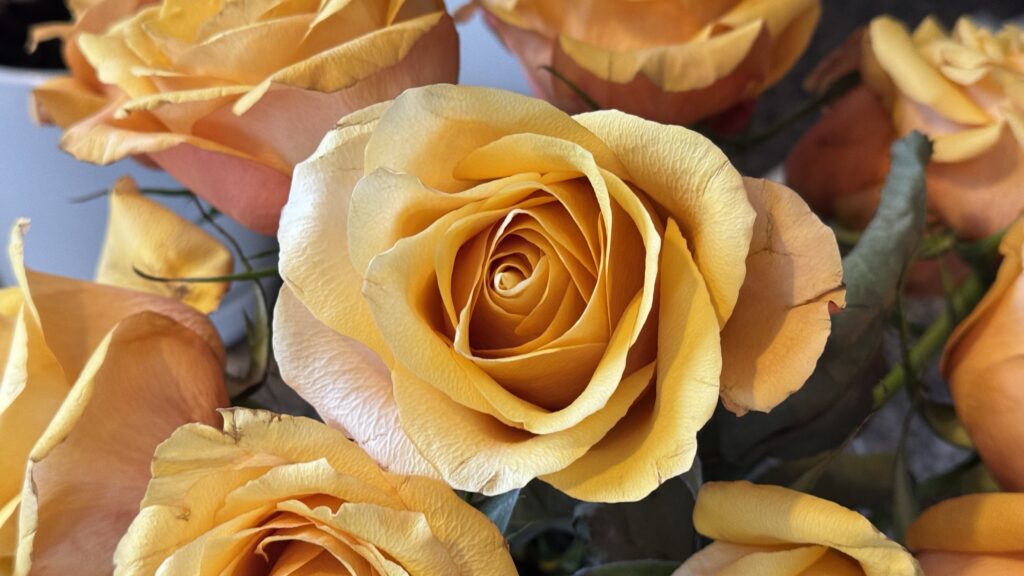
More than a week later, all twelve were still there, fully unfolded and looking so spectacular that my husband finally asked whether they were fake. I’d caught myself wondering something similar, despite knowing I’d brought them home as reluctant little possibilities rather than magnificent silk impostors.
What surprised me most wasn’t how long the roses lasted, but how close I’d come to walking past them altogether, convinced I already knew what would happen.
I had a disappointing history with roses, one that had become a dependable prediction. They weren’t my flowers. They didn’t last. They rarely opened properly. I’d gathered enough evidence over the years to consider the matter settled, which is a convenient way to live until something unexpectedly beautiful asks us to reconsider.
I recognize that tendency in other parts of my life. I can be curious and adventurous, willing to experiment with the unfamiliar, while still carrying firm expectations about how things ought to turn out. Some expectations are grounded in experience and sound judgment. Others are old conclusions I’ve stopped examining.
Lately, I’ve been learning something about receiving help that has challenged those beliefs. I’ve spent much of my life being resourceful and independent, comfortable figuring things out and finding my own answers. I wear the DIY-er badge with a little too much pride.
Asking for help has become easier, but receiving it fully is another matter. I can appreciate someone’s perspective while quietly assuming that the responsibility for finding the answer still belongs entirely to me. I’ve also overlooked the value of what’s been offered until much later.
My friend’s rose suggestion was a passing observation, shared without any expectation that I’d do something with it. She couldn’t have known that weeks later I’d be standing in a grocery store debating the merits of an eight-dollar bouquet. Neither could I.
Yet there it was, returning to my awareness just when I needed it. I hadn’t sought the information, but I’d received it. In a way, I’d received it twice: first when she shared it, and again when I allowed myself to use it.
I’ve often thought about my relationship with God, Universe, Source — I sometimes call the whole magnificent mystery GUS — in terms of guidance and trust. I believe there is wisdom available to us beyond what we can see or reason our way toward, and receiving it requires something of me, too. I have to remain open enough to recognize it, even when it arrives in an unexpected form or long before I understand why it matters.
I can’t say whether the technique made the difference, the flowers were unusually fresh, or I stumbled upon a remarkably resilient dozen. I’m content to leave the horticultural explanation open. What interests me more is my own participation in what happened.
I had to notice the roses despite my expectations, remember the suggestion, and trust the nudge to experiment. I continued caring for the flowers without knowing whether my efforts would matter. But the opening itself was beyond my control. I could provide water, attention, and a little encouragement, but I couldn’t reach into the center of a rose and persuade its petals to unfold any faster.
That arrangement is both comforting and uncomfortable. I like knowing my choices matter, and that attention and effort can influence what becomes possible. Yet I’ve learned how easily that belief can easily turn into an expectation that I should be able to manage the outcome. Waiting can feel like doing nothing, even after I’ve done what was mine to do.
I’m learning that surrender begins earlier than I once believed, not only when I’ve exhausted my efforts and must release the result, but when I’m willing to reconsider what I think I know and receive something I hadn’t thought to ask for. Surrender doesn’t mean withdrawing from the process. It means remaining involved without insisting that my involvement gives me control over the timing or the outcome.
Of course, not everything unfolds beautifully. I’ve tended enough plants that never bloomed and watched plenty of plans go sideways to know that patience and trust don’t guarantee a lovely ending. Some flowers droop no matter what we do. Some hoped-for outcomes never arrive, and calling them perfect simply because they happened diminishes the disappointment of wanting something else.
Still, I wonder how much beauty I’ve overlooked by deciding too soon what something was capable of becoming, mistaking its first appearance for its final one, or assuming that because I couldn’t see anything changing, nothing was happening.
The roses didn’t answer that question. They simply kept opening, a little differently each day, until the tightly folded flowers I’d almost walked past had become something I wouldn’t have recognized in the grocery store.
All twelve of them.