Of all the things my parents needed to part with when they downsized their home of fifty years, my mother’s sewing machine was one of the hardest.
She wanted me to have it. I didn’t want to take it. And for months, we kept returning to the same conversation, neither of us quite ready to accept the other’s answer.
Sewing had been part of our family for generations. My grandmother had an old treadle sewing machine, housed in a wooden cabinet my mother had lovingly restored. I remember sitting at that machine, guiding sheets of paper beneath the needle and listening to the rhythmic punctures as I stretched to keep the pedal moving with my small feet. My mother wanted me to have it, but there wasn’t room in our house, and it didn’t quite fit our style. My sister lived in a house built in the early 1900s, where it would look right at home. Fortunately, she had the space and was happy to give it a place.
The modern sewing machine was different. My mother imagined me using it, perhaps because she’d watched me sew for much of my life, or because she knew the pleasure of returning to something creative after years devoted to other responsibilities. In retirement, she’d taken up quilting in earnest, making beautiful things with the same patience and care she’d brought to sewing throughout her life.
I understood that pleasure. I also knew I hadn’t sewn anything in years.
As a young girl learning to sew, I was determined to get everything right. I cut carefully along the printed lines of tissue-paper patterns, studied the instructions, and tried to follow each step exactly as written. There was something reassuring about believing that someone had already figured out how all the pieces should come together. If I measured correctly, cut accurately, and followed the directions, surely the finished garment would look like the picture on the envelope.
Except sometimes it didn’t. Occasionally the instructions left something out or assumed I knew something I hadn’t yet learned. Sometimes the proportions weren’t quite right, even though I’d chosen the correct size. And sometimes I simply didn’t like the way a particular detail looked once I’d sewn it together.
With my mother’s help and growing confidence in my own abilities, I began making adjustments. I learned the printed lines were a starting point and that understanding how something was constructed gave me options the instructions never mentioned. I could shorten a sleeve, change a neckline, combine elements, or abandon a detail altogether.
By the time my engagement was announced, my mother and I were confident enough to tackle something considerably more ambitious. I couldn’t find a wedding dress I wanted, so we searched for patterns that might help us create my dream dress.
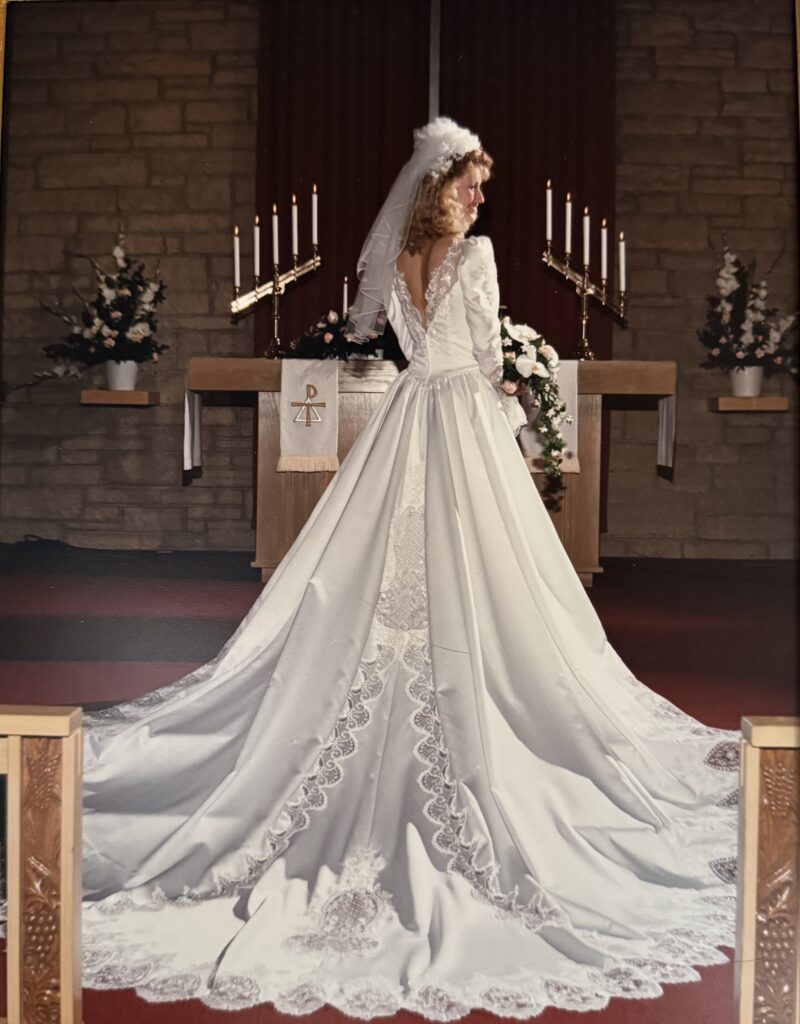
Five patterns. One dress.
It took us a year to finish, including more than a hundred hours I spent sewing beads and sequins by hand.
I loved that dress. I loved creating it with my mother, figuring out how to make the pieces work together and watching something we’d imagined become something I could wear. Years later, I designed my son’s christening outfit, and my mother brought it to life, another piece of clothing that carried far more meaning than the fabric and thread from which it was made.
There were other projects, too, some more practical than inspired. I remember hemming my son’s baseball pants and making a valance for the guest room because I’d found the perfect fabric. By then, the sewing machine had become as much a useful household tool as a creative outlet. It was still satisfying to make something myself, but somewhere along the way, I stopped reaching for it.
I don’t know the moment sewing ceased to be part of my life. There was no decision to quit, no unfinished project that defeated me, no particular frustration that made me put the machine away for good. Other interests and responsibilities gradually claimed my attention until years had passed without my missing it enough to begin again.
Or so I thought.
When my mother wanted me to take her machine, I was unexpectedly unsettled by the question of why I no longer sewed. I remembered the satisfaction of making something beautiful and uniquely mine, the pleasure of finishing a project and seeing it become part of our lives. A handmade quilt spread across a bed has a presence that is difficult to ignore. A wedding dress becomes part of a family’s photographs and stories. Even a child’s christening outfit carries memories long after its tiny owner has outgrown it.
I still long for that kind of creativity sometimes, for making something tangible I can hold in my hands and point to with the uncomplicated satisfaction of having made it.
Writing gives me a different version of that pleasure. I can spend hours working through an idea, rearranging sentences, discarding whole passages, and trying to make something that began as a vague feeling take a recognizable shape. But a finished essay doesn’t announce itself in a room the way a quilt does. Its usefulness is less visible, and whatever someone might carry away from reading it may never be known to me.
That’s partly why I miss sewing. The evidence that something has been made, that the work of my hands has produced an object with a life beyond the making.
My mother’s relationship with her sewing machine had become more complicated for reasons neither of us could change. As she grew older, physical limitations made the movements required for sewing increasingly difficult. She still loved it, especially quilting, but wanting to do something and being physically able to do it were no longer the same.
During those months of downsizing, I began to understand how much hope could reside in an ordinary household object. Keeping the machine meant leaving open the possibility that she might sew again. Giving it away required acknowledging that the future might hold fewer opportunities to do something she’d loved for so long.
And there were so many things she was already being asked to release.
I was painfully aware that these decisions were different for her than they were for me. I could choose to sew again someday. I could buy another machine or borrow one if the desire became strong enough. For my mother, the possibilities were narrowing in ways that had little to do with choice. Each decision to give something away seemed to carry an acknowledgment of a life changing in ways she hadn’t necessarily wanted.
I didn’t want to add to that sadness. I certainly didn’t want to disappoint her.
For a while, I wondered if taking the machine would be the kinder choice. Perhaps I would use it again someday. Perhaps having it nearby would rekindle an interest I’d simply neglected. I’d held onto my violin for decades for much the same reason, imagining that one day I might return to playing or that a child of mine might want to learn. Eventually, I’d let that go, too.
I knew how easily the possibility of returning to something could become a reason to keep carrying it.
And I knew what it would feel like to have that machine sitting unused in my house. Every time I saw it, I might remember the woman who had made her own wedding dress and wonder why I wasn’t making anything like that anymore. Something that had once brought me joy would become a quiet reminder of what I wasn’t doing.
Yet declining it felt like more than a practical decision about space or whether I’d sew again. Somewhere beneath the guilt was a familiar impulse to be the daughter who didn’t disappoint her mother. The one who appreciated what was offered, understood what it meant, and found a way to make it work.
For much of my life, I might have accepted the machine simply to avoid the discomfort of saying no. I would have found a place for it, assured my mother that I was happy to have it, and carried home something that represented a version of myself I wasn’t sure I wanted to return to. I might even have convinced myself that I was doing the loving thing.
But I now recognize the cost of that familiar pattern. I’d spent years learning I could make decisions other people wouldn’t choose, including people I loved, without threatening the relationship itself. Love didn’t require me to eliminate every possibility of disappointment, although knowing that and acting on it were still two very different things.
And this wasn’t an ordinary decision. My mother was being asked to surrender things she might never be able to reclaim, while I was trying to give myself permission not to reclaim something simply because I once loved it. I couldn’t overlook that difference. I wanted to honor what she was losing without agreeing to preserve it for her in my own life.
I thought again about the girl who had worked so carefully to cut along the printed lines, afraid one wrong move would ruin the fabric. It had taken me years to understand those lines were meant to help me make something, not dictate what I was allowed to create.
Apparently, I’d learned to trust my judgment with fabric long before I was comfortable doing the same in some of my closest relationships.
During our final conversation about the sewing machine, my mother remained hopeful she might sew again, despite her increasing physical limitations. I asked her to raise her hands as she would need to when sewing. She tried, but couldn’t lift them high enough. My dad and I watched with tears in our eyes as she acknowledged something she’d long hoped would be different.
She agreed with my suggestion to give the machine to my college best friend, who helped sew some of my bridesmaid dresses and still finds great joy in sewing. She quilts, makes holiday outfits for her grandchildren, and is teaching her daughter to sew. The machine would be used, cared for, and appreciated in ways neither my mother nor I could offer it now.
I felt relief, but also a sadness for what my mother was giving up and for the younger version of myself who once spent hours choosing fabric and imagining what it might become. I also wondered whether my mother understood that my decision wasn’t a rejection of her or the things she’d taught me. I hoped she did.
Recently, I caught myself studying a shirt and imagining how it might look with contrasting fabric on the collar and cuffs. Perhaps I’ll surprise myself and take up sewing again someday. Our fortieth wedding anniversary is only three years away, and if I make another dress, I suspect it will involve considerably less beading and be better suited to dinner somewhere in Thailand or Argentina.
For now, there are other things I want to imagine and create. And I’m discovering that even the reliable patterns I’ve made for myself deserve another look now and then.